Today's world of work is changing rapidly. New technologies, changing customer needs, and increasingly dynamic forms of collaboration are constantly emerging. Companies are facing the challenge of training employees as quickly and scalably as possible, particularly in customer service, sales, and leadership.
In this interview, Matthias Bomatter, Head of Learning Solutions, Integrated Talent Management Leadership, and eLearning specialist Tanja Laïbi from Zurich Insurance Company Ltd tell us how Zurich Insurance Company Ltd is addressing this challenge in communication and what role 3spin Learning plays in this.
Change, Turnover, and the Pressure to Perform Quickly
What has been the trend in demand for training courses at Zurich?
Matthias Bomatter: For years, we have seen a sharp decline in the average length of time employees stay in customer service and sales. For us as an organization, the challenge is one of constant recruitment, ongoing onboarding, training and education of employees, and turnover management. We cannot afford to run three- or six-month onboarding programs. Our goal is to get employees up to speed as quickly as possible. And in our pilot project with 3spin Learning, we found that employees are “ready” much faster thanks to the exercises.
This applies not only to customer service, but also in a leadership context, for example in difficult conversations or performance management. Traditional role-playing often reaches its limits here.
How did you find working with our platform?
Tanja Laïbi: We created our own training scenarios in customer support, sales, and HR leadership. It was very intuitive. After a short training session, we were able to get started right away. We quickly resolved the most difficult questions, such as those about avatars or prompt limitations, in direct communication with your team. This gave us an extremely steep learning curve right from the start.
A huge plus point: we don't have to send 20 people into a room with a trainer. Employees can play through the scenarios repeatedly at their workplace, regardless of location and time. This makes the tool extremely scalable.
What sets our solution apart for you?
Matthias Bomatter: The editor is a real USP for us. We can easily transfer scenarios to different areas. A train-the-trainer approach works extremely well; we don't have to rely on a central team to create everything. Furthermore, we don't see your solution in isolation, but rather as a supplement to a blended learning approach. We often continue to combine it with classroom training.
Better Role-Playing than with Humans
How do you assess the educational impact in the context of leadership?
Tanja Laïbi: In traditional leadership training courses, we often do role-playing exercises. The first round goes well, but from the second round onwards, participants prefer to discuss rather than act. The alternative would be to use professional actors, but that is not scalable.
Several participants said unprompted:
That impressed me. A key moment for me personally was a scene with an overworked young mother who is regularly late. Although we were only working on screen, it touched me emotionally. That's when I realized: Wow, it's really working.
How do your employees perceive AI feedback?
Matthias Bomatter: People have a lot of trust in AI. The feedback is very clear, direct, and to the point. Of course, every AI has a certain confirmation bias.But right now, our belief in technology is actually helping us. Users accept the feedback and implement it.
What did you particularly appreciate about our collaboration?
Tanja Laïbi: Definitely your speed. We never feel like a request disappears into a black hole. And you are open and transparent when something is not possible. I have rarely experienced this kind of response time with other suppliers.
First Results: Subjectively very high Benefit
Have there been any measurable findings yet?
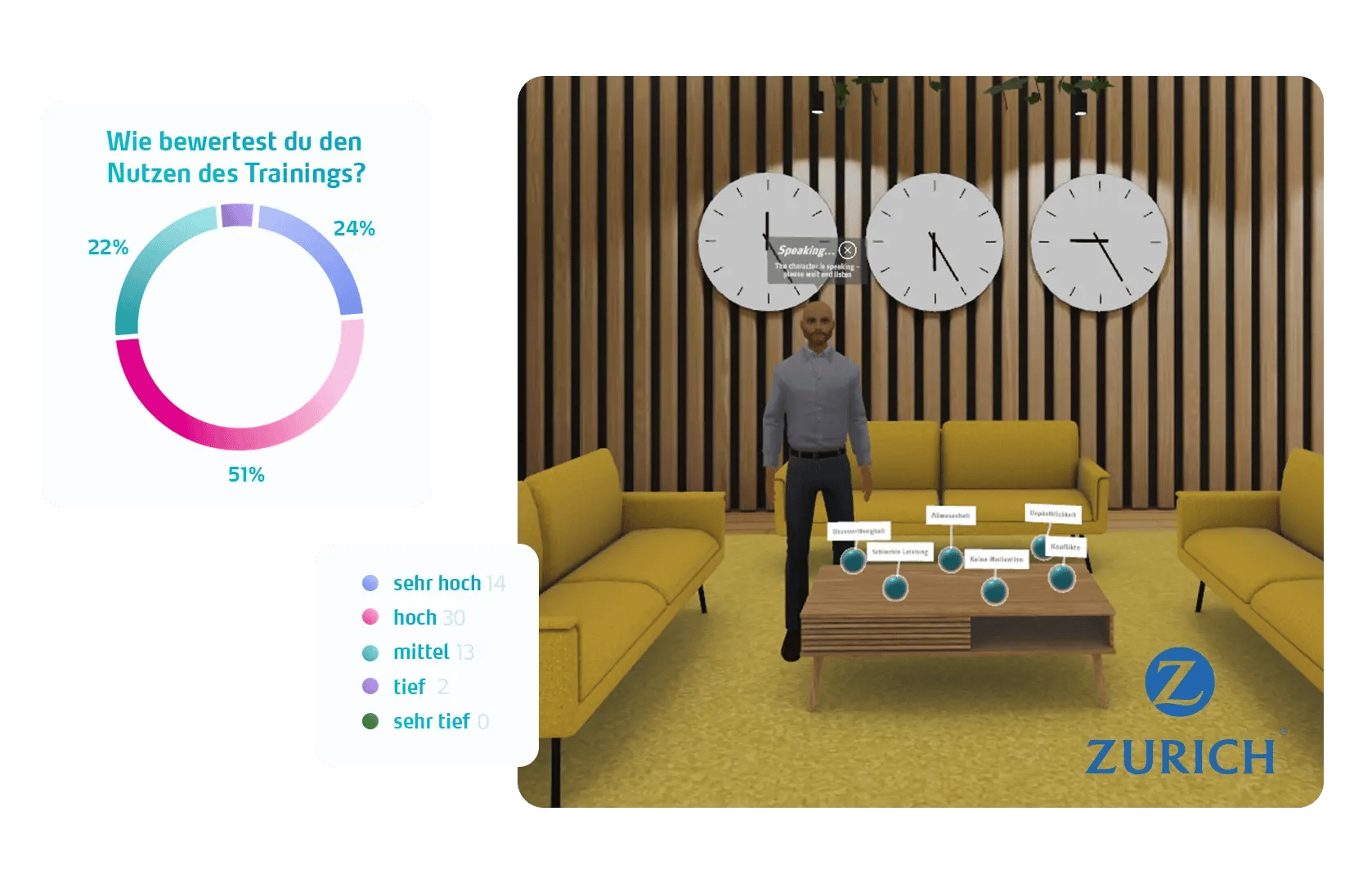
Matthias Bomatter: Yes, in our pilot survey:
- 75% of the 61 participants rated the training as highly or very highly beneficial.
- Compared to documentation, educational films, WBTs, learning guides, and live events, 3spin performed better in almost all areas; only live training courses were similar, as expected.
What is particularly valuable is that participants actually perform the role-play scenarios instead of just talking about them. This makes an enormous difference to the effectiveness of learning.
What happens next?
Tanja Laïbi: An exciting next step would be to translate the potential into hard figures. If a service center says that employees are ready to work faster thanks to the simulations, then that is worth money. If someone can conduct customer meetings after four weeks instead of eight, that is a clear business case. We are currently collecting data for this purpose.
The Bottom line
Zurich Insurance Company Ltd. provides an impressive demonstration of how AI-supported simulations can complement and improve traditional soft skill training. Its collaboration with 3spin Learning enables it to quickly and flexibly introduce modern training formats into the organization.
The case study shows that when people practice real conversations with AI instead of actors, learning becomes not only more sustainable, but also more realistic and efficient.
About
Matthias Bomatter is Head Learning Solutions foucussing on Integrated Talent Management Leadership. Tanja Laïbi is eLearning Specialist. At Zurich Insurance Company Ltd, both pursue a vision of empowering people to take responsibility for themselves, recognize a meaningful purpose, and actively contribute to the common good.


.webp?width=1454&height=969&name=3s_whitepaper_header_visual%20(2).webp)