3spin Learning CEO Thomas Hoger explains in the SAP Education Newscast why now is the right time to rethink soft skills training and finally go digital.
How is artificial intelligence changing soft skills training in companies? And why are AI avatars potentially the decisive lever for finally training communication in a systematic and scalable way?
In the SAP Education Newscast podcast, Thomas Hoger, CEO and co-founder of 3spin Learning, spoke with SAP Digital Ambassador Thomas Jenewein about these very questions on the occasion of 3spin Learning being named one of the top 3 learning innovations for 2025.
This 20-minute episode provides exciting insights into the future of AI-supported communication training, immersive learning, and practical role-playing in browsers and virtual reality.
From VR Trailblazer to AI Innovator
How 3spin Learning Came to Be
For years, 3spin Learning has been a technological pioneer in immersive learning with virtual reality. What began as a VR authoring platform has undergone consistent development in recent years. Today, the focus is on AI-based role-playing games for soft skills.
3spin Learning combines technology with teaching expertise to make difficult conversations digitally trainable in a realistic, repeatable, and scalable way. Our success talks for itself. In 2025, 3spin Learning was recognized as one of the top three learning innovations.
Why Soft Skill Training Hasn't Been Digitized Much Yet
While specialist knowledge is now naturally imparted via learning management systems, microlearning formats, or digital academies, practical communication training in many companies is still organized in a surprisingly analog way.
Those who want to learn how to give constructive feedback, conduct a difficult employee appraisal, or respond confidently to customer complaints usually end up in a face-to-face workshop. There, role-plays are often carried out once, under time pressure, and in front of colleagues. This is organizationally complex, costs time and money, and above all, offers one thing very little: repetition.
However, repetition is crucial. Communicative competence does not come from reading models or looking at slides, but from practice, ideally multiple times, in different variations and with the opportunity to make mistakes. In practice, there is rarely room for this. After the workshop, it's back to everyday life, and what has been learned is often tried out for the first time in a real, possibly critical situation on the job.
However, the following skills are precisely what make the difference in everyday business life:
- How do you give feedback without demotivating people?
- How do you resolve conflicts within the team early on, before they escalate?
- How does a sales representative respond to a tough price objection?
- How do you stay calm when customers become emotional or unfair?
- And how do you de-escalate situations where stress, time pressure, or public attention come into play?
Thomas Hoger sums it up in the SAP Education Newscast. While knowledge transfer has long been digitized, there is a massive digitization gap in the area of dialogue-based soft skills. Ironically, the skills that have the greatest impact on leadership, sales success, and customer satisfaction have hardly been systematically trainable digitally until now.
And this is exactly where the approach of AI-supported role-playing and immersive learning comes in as a response to a structural training deficit.
AI Avatars in Soft Skill Training
3spin Learning's solution addresses this challenge by transforming dialogue-based training into a digital, scalable format. At its core are AI-driven 3D avatars that learners can use to have real conversations without predetermined response options or rigid decision-making schemes. The artificial intelligence reacts in real time to what is said, picks up on arguments, shows emotions, asks questions, or increases the pressure of the conversation in a targeted manner depending on the scenario.
AI-supported Soft Skill Coaching Instead of Multiple-Choice E-Learning
Instead of traditional multiple-choice tests, we use realistic conversation simulations that closely resemble everyday working life.
Those who practice feedback conversations experience how their counterparts react defensively. Those who train in handling objections have to deal with critical or price-focused customers.
Those who practice de-escalation can feel how a situation can become emotionally charged and learn to consciously counteract this.
This transforms passive e-learning into active, dialogue-based learning with immediate feedback from AI.
Digital Role-playing using 3D Avatars in a Web Browser or in VR
Technologically, the training is based on AI-supported conversation in interactive 3D environments. The avatars can be used either directly in a web browser or in virtual reality.
What makes it special is that over 80% of users now train browser-based without VR glasses. This significantly lowers the barrier to entry and makes immersive learning feasible even for large organizations.
Unlimited Repetition as a Success Factor in Soft Skills Training
A key advantage of digital AI role-playing games is their unlimited repeatability. Conversations can be practiced as often as desired, variations can be tried out, and strategies can be refined.
Mistakes are not penalized, but serve as learning opportunities. Unlike in face-to-face workshops, the training does not end after 20 minutes of role-playing, but can be continued indefinitely.
This opportunity for repetition is a decisive learning lever, especially when it comes to sensitive topics such as conflict resolution, feedback, or redundancy talks.
Individual Training Scenarios
Businesses can customize the training courses. Conversation partners can be defined via prompts, for example as particularly critical, dominant, or uncertain. Your own sales models, products, or management guidelines can be integrated.
This creates tailor-made scenarios without any programming effort, which is perfect for scaling in corporate learning.
More Training, Less Inhibition
Often overlooked is the protected training environment. Learners practice without an audience and without social pressure, yet still in an emotionally realistic situation.
This significantly lowers inhibitions and increases the intensity of the exercise. People who tend to hold back in traditional role-playing exercises particularly benefit from this form of digital communication training.
Scalable Soft Skill Training for Large Organizations
Browser-based use makes immersive soft skill training truly scalable for the first time. Hundreds or thousands of employees can train simultaneously without hardware rollouts or complex logistics.
Immersion is thus no longer an exclusive, high-end setup, but a practical component of modern personnel and team development.
Real-World Example
De-escalation Training at Lufthansa
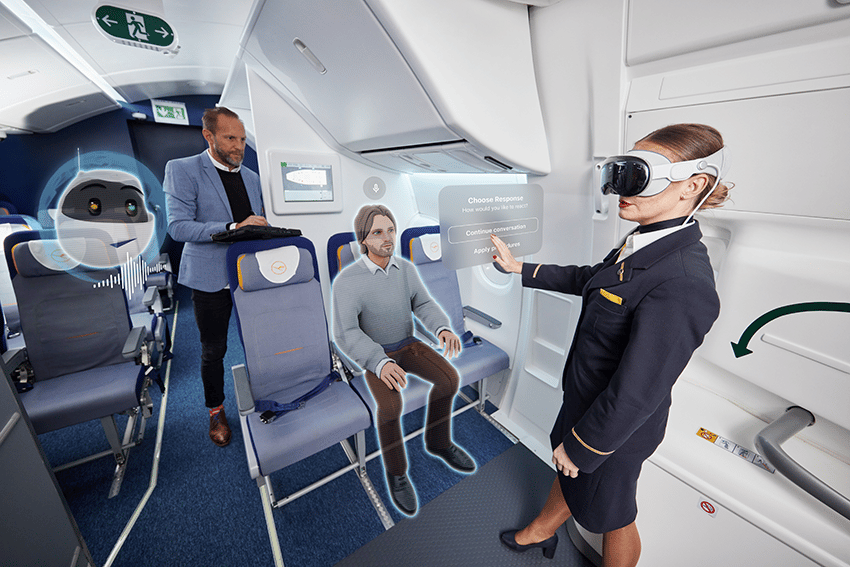
One well-known application is Lufthansa Aviation's training of flight attendants in dealing with difficult passengers. Flight attendants practice how to behave in situations where, for example, safety instructions are refused or situations escalate, before they have to act in real flight operations.
The advantage of AI-supported role-playing games is particularly evident in sensitive conversation situations:
- Making mistakes is allowed
- Situations can be repeated as often as desired
- Emotional reactions are simulated realistically
The Productivity of VR
In the SAP podcast, Thomas Hoger also talks about the frequently discussed topic of whether virtual reality in corporate learning was just hype.
His answer is nuanced, because VR is no longer just hype, but is now in productive use.
For example, our partner TÜV Nord Akademie trains with over 400 VR headsets at more than 20 locations throughout Germany and integrates VR into regular face-to-face seminars. At the same time, 3spin Learning deliberately pursues a pragmatic approach and knows that browser-based training is part of successful scaling.
This combination lowers the barriers to entry and increases acceptance in companies.
No Code Editor
Customized Training on Demand
One key innovation at 3spin Learning is our integrated no-code authoring tool. While traditional simulation training often requires complex programming or external development, companies can use this tool to design their own customized training scenarios without any prior technical knowledge.
At its core, the system works using intelligent prompting. Conversation characters can be precisely defined in a similar way to generative AI models:
- Should the other person react in a particularly critical manner?
- Act in a dominant way?
- Behave in an uncertain or emotional manner?
Character descriptions create specific conversational behavior that responds realistically to learners' input. In addition, companies can integrate their own sales approaches, leadership guidelines, or communication models. The training can be adapted to existing concepts instead of working with generic standards.
Product-specific content can also be added. Sales employees not only train in general objection handling, but also practice real arguments about specific products or services offered by the company. In addition, it is possible to connect your own custom GPT models if your company has already trained internal AI systems.
The result is tailor-made soft skills training that can be created and adapted without any programming effort. This means that individualization is not a question of budget, but a strategic component of modern personnel development.
Why AI-Powered Communication Training Is Becoming Relevant Now
It is no coincidence that AI avatars are currently gaining so much importance in soft skills training. Several developments are currently converging and reinforcing each other.
Firstly, artificial intelligence has become part of everyday business life. Employees have long been using generative AI tools for research, text work, and analysis. Acceptance of AI-based applications has increased significantly, including in the context of learning.
Second, communication skills are becoming increasingly important due to hybrid and remote working models. Leadership is more often virtual, teams work together across locations, and customer contacts have become more digital. Misunderstandings, conflicts, or a lack of empathy have a faster and stronger impact in such structures. Soft skills are therefore not “nice to have” but business-critical.
Thirdly, companies are under pressure to make training solutions scalable and efficient. Face-to-face formats alone are no longer sufficient to continuously develop large organizations. What is needed are digital solutions that are repeatable, measurable, and flexible.
Fourthly, the technological barriers to entry have fallen dramatically. Browser-based applications, cloud infrastructures, and user-friendly interfaces enable rapid implementation without complex IT projects. At the same time, the cost models are designed in such a way that not only large corporations but also medium-sized companies have access to innovative soft skills training.
This makes practical communication training digitally scalable and economically attractive for the first time. AI-supported soft skills training is thus evolving from an innovation project to a strategic standard tool of modern organizational development.
Conclusion
AI and Immersion as Strategic Levers
The award as one of the top three learning innovations of 2025 highlights that AI avatars in soft skills training are no longer an experiment, but a productive solution to real challenges.
The combination of AI, immersive learning, realistic dialogue simulations, and scalable web deployment makes practical conversation training digitally and economically accessible for the first time.
Or as the SAP podcast makes clear: Technology is not an end in itself. It must have a measurable impact. And this is exactly where 3spin Learning comes in.
Listen Now
SAP Education Newscast with Thomas Hoger
If you want to delve deeper, you can find the complete podcast episode here.: