An interview with Dr. Sanaz von Elsner
Artificial Intelligence changes the way we lead, learn, and collaborate. What does the future hold for leaders and talent development? And which skills will prove most important as AI takes on more and more tasks? We spoke with leadership coach Dr. Sanaz von Elsner about these issues.
Dr. Sanaz von Elsner supports executives as well as founders and co-founders of startups and scale-ups through coaching and change processes. About 80 percent of her work consists of one-on-one coaching sessions, often with executives at high levels of the hierarchy, internationally, and during their transition into a new role, for example.
Her goal is to improve collaboration among people and equip them with tools for their own development. But it is precisely this collaboration that is currently undergoing a fundamental transformation. That’s because, in addition to people, another player is increasingly taking a seat at the table: artificial intelligence.
We spoke with Sanaz about what this means for leadership, why AI competence is more than just prompting, and why we shouldn’t simply optimize away human friction.
How’s AI Changing the Game for Leaders Right Now?
Sanaz, you work with many leaders and companies. What are you currently observing as a result of the increasing use of AI?
SvE: We’re currently experiencing a massive transformation. This raises some very fundamental questions for companies:
- How do we want to position ourselves for the future?
- How are our employees coping with AI?
- What skills will we need in the future?
I believe we need to focus on how we can bring people along with this development. Personally, I try to remain open to new technologies. Just because something wasn’t possible before doesn’t mean it can’t work. At the same time, I see uncertainty among many people. And, of course, there’s also the question of how work will change when AI allows certain tasks to be completed more quickly.
Will AI enable good leaders to become better and bad ones to become worse? Which skills will become more important in this emerging work environment?
SvE: I am intrigued by the assumption that people who already critically evaluate information and ask good questions could become even faster and better at doing so thanks to AI. On the other hand, people with limited expertise who use AI uncritically might accept results without being able to truly evaluate them. This could actually widen the gap between different skill levels even further.
For me, therefore, AI expertise is not simply about being able to use a tool. I need to be able to ask good questions, evaluate sources, and verify numbers, data, and facts. If I have no understanding of the subject matter myself, AI might provide me with information that I might not even recognize as incorrect.
Many executives already use AI as a sparring partner today. How can an AI system help in this regard, and what are its limitations?
SvE: AI can be a great sparring partner. People can ask ChatGPT, Claude, or other systems about a problem and get some initial insights that way. But executives, in particular, often look for the human aspects.
A coach, for example, can deliberately challenge someone. Once trust has been established, I definitely use challenge as a method. I might see something that the person I’m working with doesn’t see themselves. If I leave such things unmentioned, I ask myself: What, then, is the added value I bring? That’s exactly why I don’t believe AI will completely replace coaches. But it can support us very well.
Especially in difficult situations or conflicts, an ever-available AI sparring partner sounds very appealing at first. Where do you see the risks in this?
SvE: Let’s take a look at a conflict between two people. If one person describes the situation to an AI, the system initially knows only that one perspective. Perhaps I don’t even recognize my own role in the conflict at all. I have blind spots and describe the situation exactly as I perceived it.
The AI is then missing important pieces of the puzzle. If, on the other hand, an AI system had the perspectives of both people, I could certainly imagine it acting in a supportive role, much like a mediator: listening to both sides, recognizing linguistic nuances, and suggesting ways to phrase things. What it can’t do is build the trust that makes genuine mediation possible in the first place.
But if I only give the AI my own perspective, it can only work with that perspective. This is precisely where critical reflection remains crucial.
AI can suggest phrasing, help us prepare for difficult conversations, and optimize communication. Isn’t that fundamentally positive?
SvE: Of course, that can be very helpful. At the same time, I think it would be a shame for our human development if we relied solely on what AI recommends. I don’t view conflicts as inherently negative.
As someone who does a lot of conflict coaching, I also see them as a kind of cleansing storm. They show us what’s currently wrong within a system. So when we constantly let AI intervene and try to prevent any friction, it raises the question for me: What do we learn from that, then?
Human development also arises from experiencing situations, making mistakes, observing reactions, and engaging with other perspectives.
Implications for Human Resources Development
If human reasoning still matters so much, what role should digital learning resources and AI play in professional development?
SvE: I consider digital components to be a very effective support tool. I have coachees who, in addition to in-person coaching, use other digital resources provided by their company or through various platforms. I very much welcome this. Digital learning can be particularly useful for foundational content. Not every issue necessarily requires a face-to-face coaching session.
Digital systems can also make learning processes transparent:
- Where does a person currently stand?
- Which sections have been completed?
- Where is there still room for development?
That’s why I believe hybrid models are the future. By “hybrid,” I specifically mean that people will continue to play a role. There will be many aspects where human guidance remains essential.
Hybrid is the Future of Leader Development
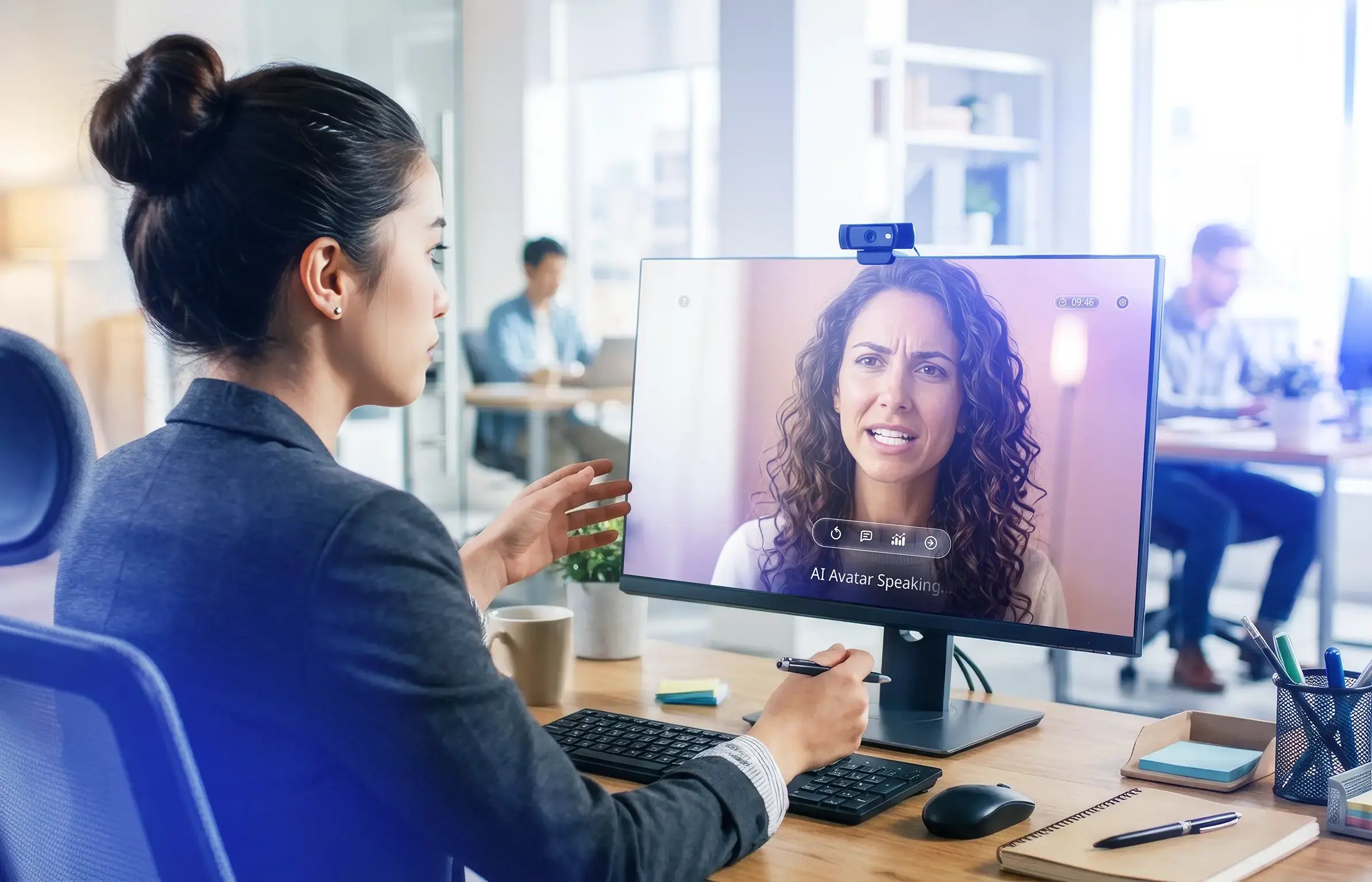
This creates an interesting division of labor for HR and Learning & Development. Not every learning or practice situation requires a human coach. Digital learning tools and AI can impart knowledge, support reflection, and create additional opportunities to practice skills in a hands-on way.
Communication scenarios, for example, can now be simulated and repeated using AI. This allows leaders to practice feedback sessions, conflict resolution, or employee reviews, receive feedback, and then test a different approach.
Human coaches, on the other hand, facilitate deeper reflection, identify individual contexts, challenge assumptions, ask probing questions, and bring blind spots to light.
This raises the crucial question for HR: “What form of learning do we need for which development task?”
Where do companies need to be cautious when using AI? What risks should HR and executives keep in mind, aside from content-related limitations?
SvE: Data protection is definitely an issue, especially when people share very personal information with AI systems:
- Where does this information end up?
- Who can use it?
- And what should I even be sharing with such a system?
In my own work, for example, I make sure to heavily anonymize cases when I use AI for reflection. Companies therefore need to approach this consciously. But I also believe that we shouldn’t put the brakes on innovation. At the same time, we don’t have to drive down the highway at 250 km/h.
We need to find a reasonable middle ground.
One of the big hopes for AI is that it will save time. Have you noticed that too? Does AI take work off managers’ hands, or does it just give them more work?
SvE: Yes. Summaries and transcripts, for example, can save an enormous amount of time. I can use them to prepare for the next coaching session or to rethink and run through methods again; here, too, the same principle applies to me as with reflection work. Personal details are left out or anonymized before I work with them. There are many ways AI can take work off our hands.
At the same time, however, I also hear executives asking: Has my workload really decreased? Or am I simply getting more done thanks to AI, which then leads to even more tasks being assigned to me?
We don’t yet know how this will play out. AI isn’t automatically just a blessing.
What's your advice to executives and HR?
SvE: Don’t close yourself off, but keep a healthy dose of skepticism. You should stay informed, consider different perspectives, and learn to understand what these systems can and cannot do. Simply experimenting a bit and then trusting that the results will turn out fine isn’t enough.
At the same time, it won’t help us to reject AI outright. AI is here to stay. The key skill, therefore, will be learning how to use it wisely.
Thank you very much, Sanaz, for this fascinating insight.
Conclusion
Great Leadership Doesn't Get Any Less Human Because of AI
AI can provide leaders with information more quickly, serve as a sparring partner, and make certain aspects of learning and development more scalable. But the interview with Dr. Sanaz von Elsner also highlights the other side of the coin. The more capable AI becomes, the more important skills such as critical thinking, the ability to reflect, conflict resolution, and the willingness to question one’s own perspective become.
For HR and L&D, this means not viewing AI as a substitute for human development. The more intriguing question is how technology and human guidance can work together effectively.
Digital training, for example, can create repeatable practice environments for specific leadership situations. Personal coaching can step in where individual backgrounds, complex conflicts, trust, or blind spots come into play.
Therefore, one of the most important leadership tasks in the AI era will be knowing what knowledge we should delegate to AI, and what we should not.
About Dr. Sanaz von Elsner
 Dr. Sanaz von Elsner has been a coach since 2016 and supports executives as well as founders and co-founders of startups and scale-ups through coaching and change processes. Her work focuses on one-on-one coaching, the transition into new leadership roles, international collaboration, and conflict resolution. Her professional background as a dentist also gives her a special affinity for topics related to the healthcare sector.
Learn more about Dr. Sanaz von Elsner here.
 “AI won't replace coaches. But AI will be a great asset to us.”