Why AI-generated content doesn’t automatically lead to better learning. 3spin Learning CEO Thomas Hoger on AI coaching, behavior change, and the future of L&D.
Thomas Hoger on AI in learning, the limitations of traditional e-learning, and how organizations can finally move from knowledge transfer to real behavior change.
AI has made it easier than ever to create learning content. But what if more content isn’t what employees actually need? At 3spin Learning’s Learning Executive Forum (LEF) in Hamburg on August 27, 2026, Thomas Hoger, CEO and co-founder of 3spin Learning, challenged a common assumption. Many organizations are currently using AI in learning primarily to make existing processes more efficient, producing more learning content faster, automating content creation, and optimizing learning platforms. But the real problem may lie somewhere else entirely.
In this interview, Thomas explains why knowledge alone doesn’t change behavior, where traditional e-learning reaches its limits when it comes to soft skills, and why AI may finally be able to bridge the gap between scalable digital learning and personalized coaching.
Thomas, one of your key points at LEF was that “AI in learning is often solving the wrong problem.” What do you mean by that?
TH: If we look at how AI is currently being used in corporate learning, a lot of the focus is on content production. Organizations can use AI to write content faster, create videos, translate courses, or generate entire learning experiences. And of course, that’s attractive. According to data I presented at LEF, 62% of organizations were already using AI to create learning content last year. At the same time, only 27% reported an improvement in learning quality. (Deloitte, 2025 Global Human Capital Trends)
To me, that captures the issue pretty well. We’re getting much better at producing more content, faster. But does that actually mean people are learning better?

“We need learning that creates greater impact. That’s why the best learning platform may ultimately be the one no one has to open.“
Thomas Hoger CEO, 3spin Learning
But isn’t knowledge transfer a core responsibility of Learning & Development?
TH: Absolutely. Knowledge matters. But for many skills, lack of knowledge isn’t really the problem. Take leadership. Most managers know, in principle, that they should listen actively. They know how feedback is supposed to be structured. They may be familiar with different communication models and may already have attended training on difficult employee conversations. But then they’re sitting across from an actual employee who says, “We’ve always done it this way,” or “I don’t think that’s fair.”
Suddenly, knowing the communication model isn’t enough. The challenge is behavior. And behavior doesn’t automatically change just because we know what we’re supposed to do.
So what does it take instead?
TH: Think about how people learn a craft. To me, effective communication is a craft as well. And we’ve known for a long time how people improve at a craft: through regular practice, feedback, and application. I have to try something. I get feedback. I reflect on what I did. Then I try again.
That sounds obvious. But corporate learning has struggled to apply this mechanism consistently because we haven’t had the right format. On one end of the spectrum, we have traditional digital learning and e-learning courses. They’re highly scalable. In theory, I can reach ten employees or 100,000 employees. But the learning experience is often passive. On the other end, we have coaching, instructor-led training, and role-play. That’s where people can actually practice, receive feedback, and reflect on their behavior. It can be highly effective, but it’s much more difficult and expensive to scale.
For a long time, we’ve essentially had two extremes:
- Traditional e-learning: scalable, but often passive.
- Coaching and role-play: practical and effective, but difficult to scale.
What we’ve been missing is something that combines scalability with hands-on practice.
And AI can now fill that gap?
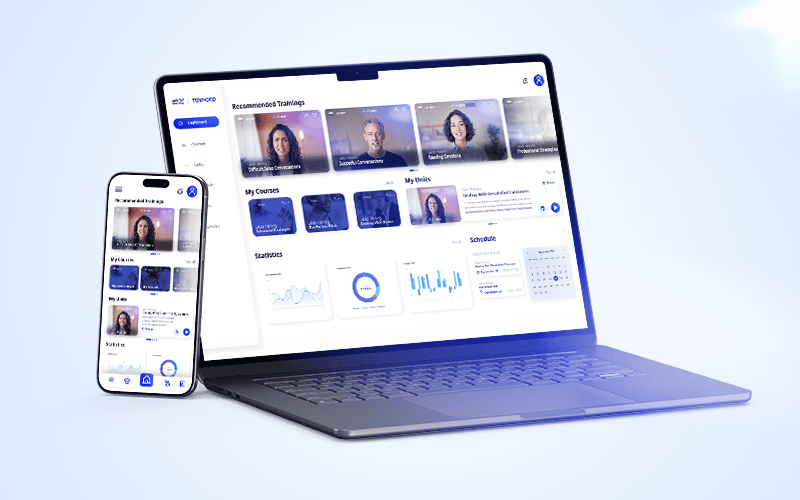
TH: That’s certainly the opportunity we see. That’s why we’re working closely with our customers at 3spin Learning on AI coaching and AI role-play. For the first time, we can make practice, feedback, and application scalable. A manager, for example, can practice a difficult employee conversation with an AI avatar. The avatar responds dynamically to what the manager says. After the conversation, the manager receives feedback and can try the same situation again.
And this doesn’t just happen once during a training session. It can happen anytime, individually, and repeatedly. That brings us to a point where hands-on soft skills training can become accessible to very large employee populations.
How Effective is Repeated AI training?
Together with PwC Germany and the University of Göttingen, we are studying both the acceptance and the effectiveness of AI-powered training. Sign up now to be among the first to see the study results.
Will employees actually accept an AI avatar as a conversation partner?
TH: That was one of the most interesting questions for us as well. What we’re seeing is that initial skepticism toward AI avatars often fades quickly once employees actually interact with them. What matters most is whether the conversation feels credible and relevant. If the avatar responds realistically and the scenario clearly connects to the employee’s day-to-day work, the interaction can quickly begin to feel like a real conversation.
That’s where I see the real potential of these simulations. Employees can test different approaches, practice challenging situations, and learn directly from the interaction. But acceptance alone isn’t enough.
What do you mean by that?
TH: Just because people like a learning format doesn’t mean it actually works. That’s a very important distinction in Learning & Development. What we really care about is whether behavior changes. That’s why we’re currently studying this new form of learning systematically together with the University of Göttingen and PwC Germany. We’re comparing different learning approaches, including coaching as well as one-time and repeated training, and looking at how actual performance changes. To me, that’s the next stage in the evolution of AI in corporate learning. We need to move beyond simply measuring engagement, completion rates, or learner satisfaction, and start measuring actual impact.
At LEF, you compared learning platforms to gyms. Why?
TH: Because the analogy works surprisingly well. Just because I have a gym membership doesn’t mean I’m getting fitter. I actually have to go to the gym and train. Learning platforms are similar. We invest a lot of effort in making content available and getting people to log into the platform. But having access to a learning platform doesn’t mean someone is actually learning, and it certainly doesn’t mean their behavior is changing. That’s also one of the challenges we often see with traditional e-learning. Even when employees open a course, that doesn’t necessarily mean they’ll complete it or apply what they learned in their day-to-day work. The metric that really matters should be whether someone can do something better after the training.
So should companies simply replace traditional e-learning with AI role-play?
TH: No. That would be too simplistic. The goal isn’t to put another new format onto a learning platform and hope everyone suddenly starts practicing voluntarily. The second major challenge is integration into the flow of work. For years, we’ve tried to take people out of their work environment and bring them into a learning platform. I think we need to reverse that logic. People shouldn’t have to go to the learning. The learning should come to them. Essentially, it’s like having a fitness tracker on your wrist instead of going to the gym.
What could that look like in practice?
TH: Imagine a manager who has a difficult employee conversation tomorrow. In the traditional learning model, that manager would first have to recognize that they need support, log into the learning platform, search for the right training, and then hopefully find the right lesson. That creates a lot of friction. Now imagine a different scenario.
The AI understands the work context, assuming the appropriate privacy, data protection, and governance safeguards are in place, and recognizes that an important learning moment is coming up. Instead of asking the manager to complete a course at some point, it could proactively suggest: “Would you like to spend ten minutes practicing this conversation first?” The manager can then rehearse the exact situation they’re about to face in the real world. To me, that’s the real paradigm shift.
So learning in the “moment of need”?
TH: Exactly. Learning becomes much more closely integrated into work itself. We bring practical learning to where people already are: their meetings, decisions, conversations, and day-to-day workflows. That’s also important because many organizations are looking for ways to connect their learning and communication systems more closely. If learning truly becomes part of the daily workflow, we may eventually move away from the traditional mindset of: “Now I’m going to log into the learning platform and learn something.”
You ended your presentation with the statement, “The best learning platform is the one you never have to open.” What do you mean by that?
TH: It’s intentionally provocative. I don’t believe learning platforms are going to disappear tomorrow. But I do believe good digital learning can become much more invisible. Today, we often expect employees to find the right learning opportunity themselves at exactly the right time. AI can change that logic. Learning can become more personalized, more context-aware, and available precisely when I need a particular skill. And if we can achieve that, we may eventually spend much less time talking about how to motivate people to learn. Learning simply becomes part of how they work. And in that sense, the best learning platform may actually be the one you never have to open.
What does all of this mean for the future of AI in corporate learning?
TH: We need to stop thinking of AI primarily as a more efficient content machine. Of course it’s useful if AI helps us create a course faster. But that isn’t the fundamental transformation. The real transformation happens when AI allows us to scale something that has historically been very difficult to scale: practical experience. People need to communicate, make decisions, resolve conflicts, give feedback, and lead others through change. Those capabilities are developed through practice, feedback, application, and repetition. If AI can make that kind of practice accessible to every employee, we’re no longer just solving a content problem. We can begin to change behavior.
AI-Powered Soft-Skills Training at 3spin Learning
That’s exactly what we’re building at 3spin Learning: AI-powered soft skills training and role-play experiences for organizations. Employees and leaders practice realistic workplace conversations with AI avatars, including performance conversations, feedback, change communication, conflict resolution, and challenging sales conversations. The approach brings together three things that have historically been difficult to combine in digital learning:
- Scalability
- Hands-on practice
- Personalized feedback
Learners can repeat scenarios whenever they need to, experiment with different responses, and deliberately improve how they communicate, all within a safe practice environment before the real conversation happens.
.webp?width=1454&height=969&name=3s_whitepaper_header_visual%20(2).webp)